Showing posts with label Permutations. Show all posts

Wednesday, April 11, 2007

Permutations and Combinations April 11th

Hey, today we started off with Mental Math, which was really hard.

Also Mr.Max before I get started, because your such a vocabulary expert, take a stab at his question,

Is "sidewards" a word?....(don't try to look it up until you think you know the answer.)
Anyways, We then went over perms and coms. We learned and reviewed the formula for permutations that nPr=n!/(n-r)! and the formula for combinations it nCr=n!/(n-r)!*r!


Lets use one of the formulas in a question and see how it works...( we did this one in class )


Ok, you have 3 & 4 digit codes with 4 digits to choose from. (1,2,3,4)


Since you're trying to find out possible codes, it matters what order the numbers are in.


And since it matters what order the numbers are in, it is therefore a permutation. The formula for permutations is nPr=n!/(n-r)! where (n) is the total number of objects to be ordered or considered and (r) is how many objects at a time are ordered. ( If you have any other questions about factorials I put up a post under factorials that you can read, it might be of some help, Mr.Max also said that these formulas would be a good thing to put on a formula sheet.)


Anyways, so this works out to 4P3=4!/1!,


4! is the same as 4*3*2*1=24,


1! is the same as 1=1


therefore 4P3= 24/1


there are 24 ways to get 3 digit codes using the digits 1,2,3, and 4.


Then you had to figure out how many 4 digit codes you could have with the numbers 1,2,3 and 4. You still use the same formula.


Except this time, it works out to:


4P4=4!/0!,


4! is the same as 24


0! is by definition equal to 1


this leave us with 4P4= 24/1 which is 24


This means that there are 24 ways to get a 3 digit code and 24 ways to get a 4 digit code.


A different way of getting the same answer is with your calculator. From your home screen you hit (n) (whatever the case may be) then MATH, over to PRB, then down to nPr or nCr, (what ever the case may be), and then ENTER, and then put in (r) (whatever the case may be)


Mr.Max said that you don't need to use these formulas if you don't want to, but you should understand then.


Also Mr.Max will be gone Tuesday, Wednesday, Thursday, and Friday, of next next week, ( I think that would be the 24th, 25th, 26th, and 27th, and he has the joy of going to talk to a bunch of teachers or something. He didn't look to enthusiastic about that. We will have a sub and probably just work on Accelerated Math, and other assigned questions.


Practice questions due for tomorrow are from the handout, #5, #11, and #14


Tuesday, April 10, 2007

Permutations

I'm going to blame being late on having to go to my grandma's for supper, and then having to go to a concert. My grandma thinks that my mom can't cook or something... anyways, I don't have much time so here it goes.

Permutations...(from wikipedia) is the rearrangement of objects or symbols onto a distinguishable sequence. Each unique ordering is called a permutation. Permutations can have no repeats either. for example... ( see if I can make one up)

if you wanted to see all the ways you could take the letters from CARS, and make two letter "words", some permutations would be...

CA, CR, CS, AC, AR, AS, RC, RA, RS, SC, SA, SR,
( see that I never used CC, AA, RR, or SS )

there’s got to be more that can be taught about this and why it’s useful but this is all I have time for...

There is software for permutations, I didn't download it because I didn't have time and whatever but it's at this link.

These are other links that I used but didn't get all the info off of...you might want to use if you have any more questions that haven’t been answered

http://mathworld.wolfram.com/Permutation.html http://www.themathpage.com/aPreCalc/permutations-combinations.htm http://regentsprep.org/Regents/math/permut/Lperm.htm http://mathforum.org/dr.math/faq/faq.comb.perm.html

Monday, April 9, 2007

Permutations

Well, well, well, I am realizing that teaching is not all it's cracked up to be. :)

Permutations are sometimes defined as any possible arrangement, or ordering, of the distinct items in a set. Or a way to arrange things in which order is important.

An example question:

If a softball league has 10 teams, how many different end of season rankings are possible? (Assume no ties)

Since we are ranking these teams that means the order is important. So we can use permutations to help us out.

We already know the formula is nPr from previous posts. So n is the number of teams we have to choose from. And we know from the information in the question that there are 10 teams.
So n=10.
R is the number of teams we are ranking at a time.
Again we know that r=10.
You put the numbers into the formula and you wind up with 10P10. After that you have to do the multiplication which is 10*9*8*7*6*5*4*3*2*1=3628800.
So this tells us that there are 3,628,800 ways to rank those 10 teams.


I hope my example question helped!

Sometimes My Light Bulb Goes 'ON'....

I am so impressed with these last few posts. You (who have posted so far) have taken some fairly big risks, since to my knowledge, there's no right way to do this....and you're doing it really well!

At risk of gushing, I'm proud of how hard you guys as a class are trying to make these little brainwaves of mine work. This is an example of why we're blogging and why I truly believe that technologies such as our blog can make the whole greater than the sum of its parts.

Really neat stuff folks, and as your teacher, I'm glad to see you learn on purpose.

RM

Permutations and such...

When Mr. Max first suggested us doing all of this research ourselves and trying out this whole 'students teaching students' thing i was quite skeptical to start with. I think that a teachers job is to teach and that's what they should do. But after talking with Mr. Max and reading what my fellow students have put on the blog, i am beginning to warm up to this idea. :)

anyways back to math....

Now i am sure this is going to be somewhat similar to what others have posted so please bare with me as i will try and find some new stuff on permutations!

A Permutation is the rearrangement of objects or symbols into distinguishable sequences. Each unique ordering is called a permutation.
as defined by the most helpful Wikipedia.

One person who played a major role in developing permutations was am man by the name of Augustin Louis Cauchy. He wrote a number of papers on the subject and this all happened around the year 1844.

Now the main formula for permutations is
---------> nPr <--------- n=is the number of digits you have to choose from
and
r=is the number of digits being used at a time (what you want)

....and if all of that mumbo jumbo didn't make sense to you, then here is an example which will hopefully help you out!

Question: >>>In how many ways can 8 CD’s be arranged on a shelf?<<<

Answer: First you must plug the numbers into the formula.
It would then look like 8P8.
After that you just have to do the multiplication which is 8*7*6*5*4*3*2*1= 40320
So there are 40320 ways to arrange that 8 CD's on the shelf. Wow that is a lot!

I am hoping that this scribe has helped you all understand permutations better. I know it helped me.

Permutations

Well this is an definitely a new way of learning, I learned quite a few things just by researching and doing this, and I hope I can learn just as easily for combinations... Sorry for any repeats. That's all.

Definition: A permutation is a set of objects that are arranged in a certain order, where the order is important.

Formula:

n is the total number of objects ; r is the number of objects chosen .
Examples:

Number 1:

You want to know how many orders your cd player will play your 13 song cd, on shuffle mode. At first there is a one in fourteen chance that any song will be played. The next song only has 1 in 12 chance of being played, because there are only 13 songs left to be played. The possibility of outcomes of a song being played decreases by one each time. The following will be the used formula.
P(n) = 13!
OR
P(n) = 13*12 * 11 * 10 * 9 * 8 * 7 * 6 * 5 * 4 * 3 * 2 * 1 =6227020800 ways of playing the same CD, in different orders.

Number 2 (from Webct learning)
How many five-letter "words" can be made from the alphabet if no letters are repeated? A "word" in this case is any five-letter arrangement with all letters different.

Solution:We will use the formula to answer this question.

The value of 'n' is 26 (there are 26 objects to choose from) and the value of 'r' is 5 (we pick five letters).


The formula may be convenient to use, but it is not essential. You can always find the number of arrangements (permutations) by multiplication as shown below.


Links
Permutations Calculator
Easy Permutations
More Examples

My Take On Permutations

First off I would like to say that this is a interesting way to learn our new unit, but it will also be quite interesting to see what we all come up with and if well we know what were talking about after all. So here i go;;;;

A permutation is an arrangement of objects in different orders. The order of the arrangement is important!!
For example, the number of different ways 3 students can enter school can be shown as 3!, or 3·2·1, or 6. There are six different arrangements, or permutations, of the three students in which all three of them enter school.

The notation for a permutation: nPr
n is the total number of objects
r is the number of objects chosen (want)
(Note if n = r then nPr = n!)

Some examples of Permutations:
1. 5P5 = 5·4·3·2·1 = 120
2. 7P5 = 7·6·5·4·3 = 2520

Here are some Questions you may see and how you can figure out how to do them using the Permutations Formula (nPr) in use!!

1. What is the total number of possible 5-letter arrangements of the letters s,w,i,n,g if each letter is used only once in each arrangement?
5P5 = 5·4·3·2·1 = 120
( 5 letters to choose from, n#, want 5-letter arrangements, r#)

2. How many different 3-digit numerals can be made from the digits of 45678 if a digit can appear just once in a numeral?
5P3 = 5·4·3 = 60
( 5 numbers to choose from, n#, want 3-digit numerals, r#)

Also, as I was searching around I found some interesting websites on Perms & Cons that were helpful to me and thought I would share them with the rest of the class;

1. http://mathforum.org/dr.math/faq/faq.comb.perm.html ( This website gives the break down of how you start out on a question and take the information and put it into the formula)

2. http://regentsprep.org/regents/math/permut/PracPerm.htm (If your not to sure your doing this unit to right you can try these practice questions with the answers)

Permutations at thier finest

Permutation is any of the numbered ways multiple objects or ideas can be exchanged or 'shuffled'.
A single permutation of the letters ABC is BAC.

Consider the following question...
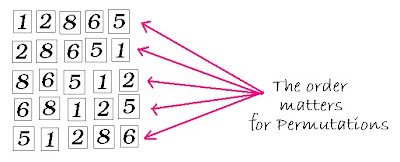
You were over at my house yesterday doing math homework. You accidentally forgot your binder and you need it now. But since I don't skip class I just tell you the password to my house's codelock. When you arrive at my house, you realize you forgot the combination. You remember the numbers, 8, 2, 1, 5, 6, but not the order they are supposed to be in. You are tempted to just start guessing random combinations. But how long would it take?


The passwords to my house is a permutation (meaning that is has to be in a specific order) and not a combination (where it doesnt matter the order as long as it includes all the correct numbers). You have only tried 5 and realized it would most likely take a very long time.
To figure out the exact number of combonations you would use the Fundamental Counting Principle formula.So there are 120 ways to put the 5 numbers into my house's comboination lock.
I hope this example question helps you realize what permutations are all about. :)